

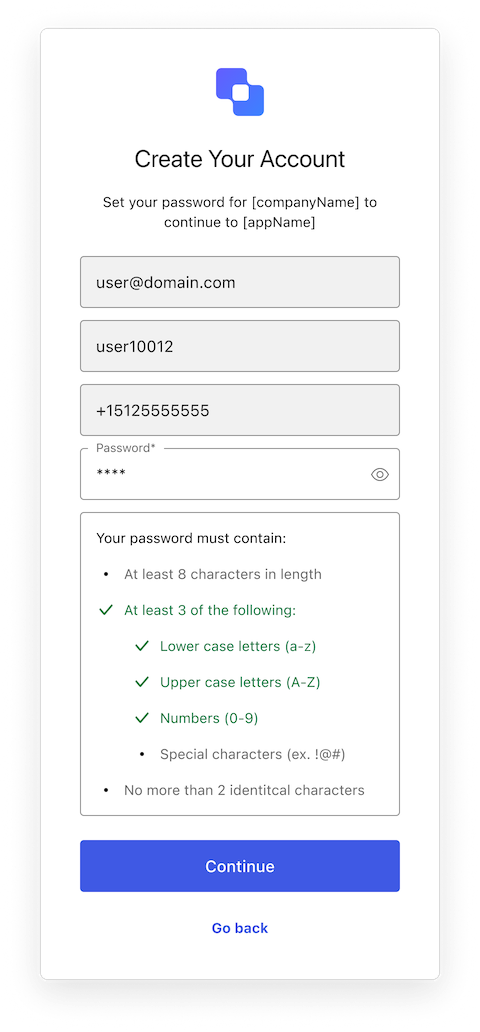
signup-password screen collects the user’s password to complete account creation. It is the second step of a multi-step signup flow, following identifier collection. It also supports federated signup via social or enterprise connections.
Import
Each screen has its own set of hooks and methods. The SDK supports partial import and root import for each screen.- Using partial import allows you to include only the code you need for your specific use case.
- Using root import allows you to load all screens from a single bundle, which is useful when you want a unified build to handle all possible screens.
Import Example
Context Hooks
Screen-scoped hooks that provide read-only access to Auth0 context data on thesignup-password screen. Import them from @auth0/auth0-acul-react/signup-password.
() => BrandingMembers
This hook provides branding configurations, such as logo, colors, and theme settings displayed on the
signup-password screen.Example
() => ClientMembers
This hook provides client-related configurations, such as
id, name, and logoUrl, for the signup-password screen.Example
() => OrganizationMembers
This hook provides information about the user’s Organization if the signup is Organization scoped. Returns
null when no Organization context is present.Example
() => PromptMembers
This hook contains data about the current prompt in the authentication flow.
Example
This hook contains details specific to the
signup-password screen, including its configuration and context.Example
() => TenantMembers
This hook contains data related to the tenant, such as
id and associated metadata.Example
This hook provides transaction-specific data for the
signup-password screen, such as active connections and current flow state.Example
() => UntrustedDataMembers
This hook handles untrusted data passed to the screen, such as a prefilled email or username from URL parameters.
Example
() => UserMembers
This hook provides details of the active user, including
username, email, and available authentication methods.Example
This hook returns all methods and context available on the
signup-password screen.Methods
Promise<void>
This method redirects the user to the Social or Enterprise Identity Provider (IdP) for signup.Method Parameters
Example
Promise<void>
This method submits the user’s password to complete account creation.Method Parameters
Example
Promise<void>
This method switches the active connection during the signup-password step, allowing the user to authenticate via a different connection.Method Parameters
Example
Common/Utility Hooks
Hooks
This hook gets the current theme options with flattened configuration from branding context.
Hooks
This hook returns a function for changing the display language on the current ACUL screen.
Hooks
This hook gets the current screen context and state.
Hooks
This hook reads and manages server, client, and developer errors on the screen.
Hooks
This hook validates the user’s password against the tenant’s password policy requirements.